What Really Happened to Jessica Savitch?
In the 40 years since her death, the pioneering newscaster has become an Icarus-like parable, a woman who was punished for her outsize ambition. She was one of the most powerful names in news, until one disastrous broadcast tarnished her golden image. In an exclusive report, those closest to her speak out about what everyone got wrong about her life.

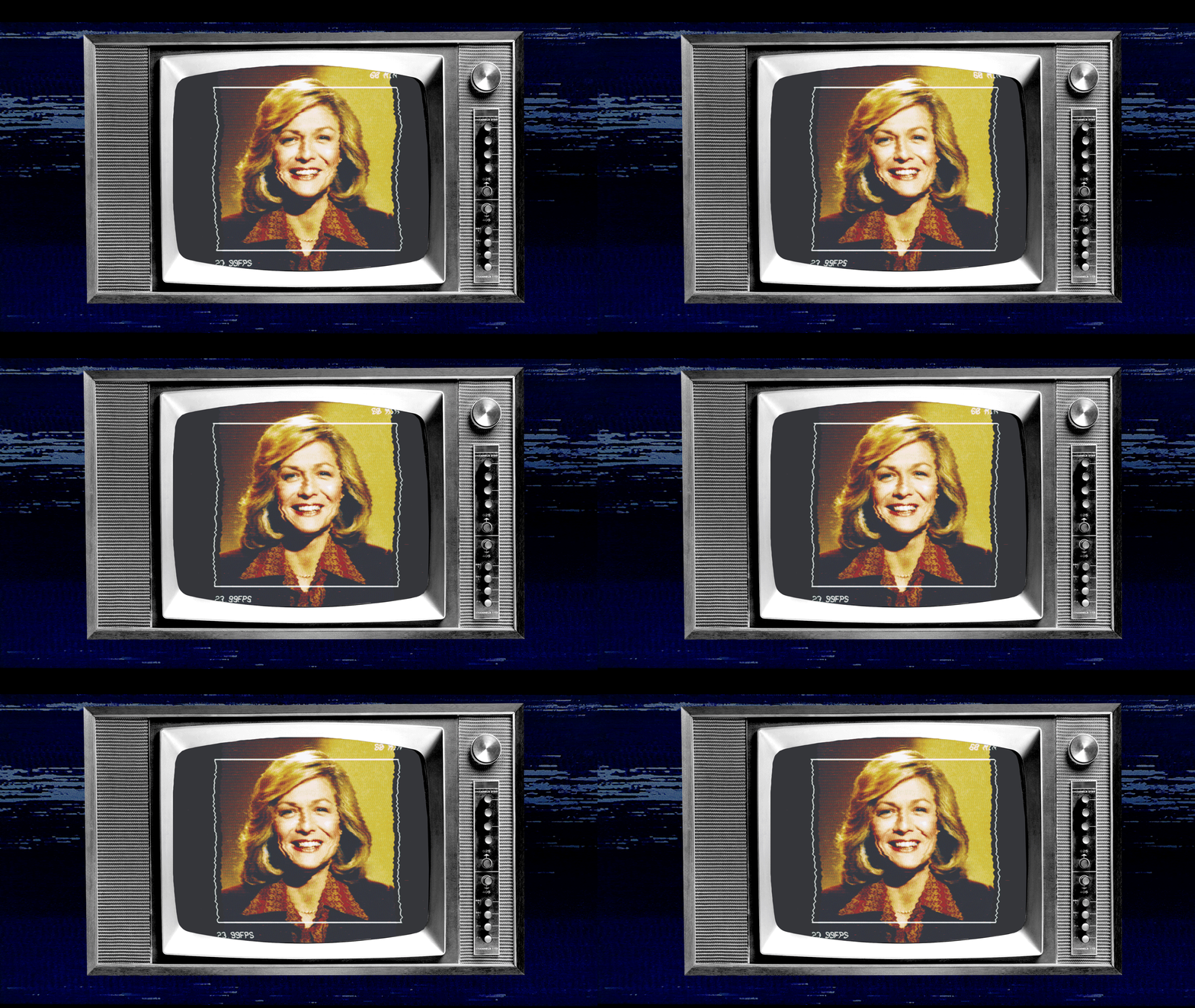
The romantic stone tavern perched on a quiet canal in New Hope, Pennsylvania seemed like the perfect getaway. Located just under two hours from Manhattan, Chez Odette, a Parisian-style cabaret where Nina Simone once performed, still lured those looking to replace New York's hard edges with dulcet tones, three-finger pours, and competent escargots de Bourgogne. On a rainy Sunday, October 23, 1983, 36-year-old Jessica Savitch, perhaps the most recognizable woman on prime-time TV, and her new love, shaggy-haired New York Post executive Martin Fischbein, 34, arrived for dinner at 5:30 p.m. The smartly dressed pair—she wore a jacket and slacks; he was in a suit and topcoat—requested a seat by the fire and ordered a bottle of white wine to share over dinner. They had spent the day antiquing and gallery hopping. They'd even brought along with them a copy of The Great Weekend Escape Book.
The typically commandeering anchorwoman was low. It had been less than three weeks since she garbled a prime-time NBC news digest—her speech halting, her jaw awkwardly slung open—in the middle of the Johnny Carson special. The event, beamed into millions of homes, got media tongues wagging. "[Savitch] slurred her way through the mini newscast—and sounded like a 45 r.p.m being played at 33 1/3," Gary Deeb swiped in his nationally syndicated column.
Savitch made broadcast history by becoming the first female news anchor in a major market and the first woman to anchor the weekend newscast for NBC News. In 1979, she was dubbed America's "Golden Girl" by Newsweek. By the age of 33, she was earning $500,000 a year from NBC (a modern $1.8 million). In 1982, TV Guide readers voted her more trustworthy than Ted Koppel and Peter Jennings. But after the on-air blunder, a doctored image of Savitch with a straw under her nose (a dig at rumored cocaine abuse) was circulating around the NBC offices. It had taken Savitch nearly two decades to climb to the top of the national broadcast heap. And only 42 seconds to fall all the way down.

After dinner, the restaurant owner's wife couldn't help but ask for an autograph, she later told the Philadelphia Daily News. Fischbein appeared to bristle at the request, but Savitch, who always obliged her fans, said yes. Around 7:00 p.m., the couple ducked back into the rain to return to the city. Savitch climbed into the back of the rented blue Oldsmobile to reunite with Chewy, her sapphire-eyed Siberian husky. In the driver's seat, Fischbein buckled his seatbelt, flicked on the lights, and drove the wrong way out of the historic building's parking lot, past two small signs that read "Motor Vehicles Prohibited," and onto a narrow pathway between the canal's overflowing basin.
Moments after responders towed the upturned station wagon from the water at 1:58 a.m. the whisper network clicked into overdrive. Had Savitch been high? Drunk? Both? Had she been murdered? Retaliation for years of hard-hitting reporting in regional markets? Had she—with all of her drive and all of her demons—somehow deserved the demise? In the 40 years since her death, a different reality has emerged.

Reporting on the “Great Debate” between Gerald Ford and Jimmy Carter in Philadelphia in 1976.
Jessica Savitch came from a different era of ambition. Hers was the radical, all-consuming conviction a woman should work. "We were raised as part of a revolution," says former WNEW-TV anchor Judy Licht, who came up with Savitch in the late '70s. "We were told, 'There's no reason you can't go for it. There's no reason you can't have it all.' We were the crossover generation that got kind of propagandized."
An early devotion to the news was sparked by her father David "Buddy" Savitch, with whom she watched the evening broadcast, and who died of kidney disease when she was only 12. "It was to win his approval that I began to follow news events," she wrote in her 1982 memoir, Anchorwoman. "His death, at the age of 33, shattered my life." According to a source close to the family, she was never given the proper space to grieve the loss. "Jessica became very anxious and obsessively driven. Something was clearly 'off.' Today, she might have been diagnosed with anxiety or depression."
The family of four women—Savitch's mom, Florence, and her two sisters, Lori and Stephanie—relocated to Margate, New Jersey, where "there was very little money," says Lonnie Reed, a long-time friend and former television news correspondent. "She was wearing threadbare clothes. I think Jessica carried that with her."

Savitch when she was awarded an honorary doctorate in 1979.
Singularly focused from a young age, Savitch nabbed her first on-air gig co-hosting the radio show Teen Corner, at WOND-AM in Atlantic City when she was only 15. While studying broadcasting at Ithaca College, she continued racking up the firsts. In 1966, she became the first female disc jockey—aka "The Honeybee"—at WBBF-AM in Rochester, New York. A few years after graduation, she secured her first on-camera role as a TV reporter at KHOU-TV in Houston; it was 1971, the same year the Supreme Court ruled employers could not discriminate on the basis of sex. There, she met reporter Ron Kershaw, who would become her first big love and her first bad romance.
It was a time when everything in network news was opaque. Though women were being hired to comply with new FCC directives, those who weren't relegated to secretarial work were rarely trained. "They didn't teach us television," says Linda Ellerbee, who would replace Savitch at KHOU-TV in Houston. In that way, Savitch succeeded in spite of the system and not because of it.
In 1972, she took her talents to Philly, where she became an on-air reporter at KYW-TV, and then an anchor the very next year. "There had been one female anchor before her. That was it," says journalist Maury Z. Levy, who wrote a profile on the emerging broadcaster for Philadelphia magazine.

There, Savitch pursued boundary-pushing stories, ones that often highlighted the private lives of women. Her five-part investigation into rape, a taboo topic in the '70s, was partially responsible for change around assault victims' rights in Pennsylvania, New Jersey, and Delaware. "As far as I know, she invented the five-part series or serialized news. It wasn't done anywhere in TV," says former producer and Savitch's friend Sharon Sakson. In late 1973, she reported a segment featuring the first live birth on TV. Reed adds, "It was groundbreaking. [The network was like] 'Nobody's going to want to see that.'"
Friends described Savitch as complicated. As a woman who held herself to an extreme standard. A woman with a short fuse who took herself seriously—maybe too seriously at times. But mostly, they described her as tenacious, as a journalist fighting to cover the kind of stories that mattered. As Ron Kershaw told biographer Gwenda Blair, "Reject Jessica, tell her no, and you would have her at the door, trying to beat the door in every fucking way, even if it bloodied her to a pulp."
Real fame didn't come her way until 1974, though, when network executives paired a 27-year-old Savitch with local legends Vince Leonard and Mort Crim (that man on whom Will Ferrell would later base boorish Ron Burgundy in Anchorman; Christina Applegate's character was inspired by Savitch herself). Newswatch—featuring Savitch as the unflappable rose between two thorns—brought out what the Washington Post eventually dubbed "the Savitch clones," a generation of women who grew up wanting to deliver the news with perfect control. "Hopefully we're past the time when every woman who goes to TV news has to be blonde and perky, because that went on for a very long time," Levy says. "And the one thing Jessica wasn't was perky."

Savitch in 1981, the year when her second husband Donald “Rollie” Payne died by suicide.
Savitch really hit her stride when she deftly improvised over raw footage of the Jonestown Massacre, in which U.S. Congressman Leo Ryan was murdered at close range. In a moment of unspeakable violence and chaos, she was beautifically serene. "Jessica was able to eliminate the screen between her and the audience," Ellerbee says. "The only other person I know that read a teleprompter that as well, and appeared to just be talking to you directly, was Ted Koppel."
Around that time, Levy pitched another profile on Savitch, this time to a national newspaper. "I turned my story in, and my editor calls me and says, 'This isn't what I wanted.' I asked, 'What did you want?' 'Well, you're too positive about her,' he said to me." The paper had been looking for dirt. "She happened to be pretty and people didn't like it."
Her relationship with Kershaw, who had given her an engagement ring, had also come undone. "It was almost as if he just couldn't bear it. He couldn't bear having 'his woman' have a very successful life in his business," Reed says. (Kershaw died of cancer in 1988.)

When Kershaw decamped for a new job at ABC in 1978, he left behind his Siberian husky, Chewy. The dog helped with the loneliness. Substances helped with the mounting pressure at work, and everything else. "Everybody did coke in that time. Its addictive nature wasn't known," Sakson says.
In recent years, a short clip of Savitch surfaced on YouTube. It was filmed in November 1979, during the early days of the 444-day Hostage Crisis at the United States Embassy in Iran. Muslim militants had just announced they would try the American hostages they were holding as "spies." Buffalo, New York was buried under 30 inches of snow. An agitated Savitch is attempting to practice for the evening's news digest, during which most Americans will hear both bits of information for the first time. She's shuffling her papers and flipping her blonde hair off her shoulder. "Can I have a rehearsal?" she demands. "Every week, it's the same story."
The video, titled "Angry Anchor," has been viewed over three million times. "She used to tell me that she had to check everything, because [the crew] would put her pages in two different places, or they would pretend that they would have a camera over on one side of the room and then move it at the last minute to another side," Sakson says. "She was a woman, so she had so much that she had to fight, and she had a lot of energy for the fight."
Finally, a weary male voice agrees to time the segment. "Three-two-one," Savitch counts down, before flawlessly delivering the news.
On screen, Savitch was indomitable. Off screen, her life was in a tailspin. By then, she'd been married twice, each ending within a year. Her first husband, advertising executive Mel Korn, filed for divorce after 10 months in November 1980. The second, gynecologist Donald "Rollie" Payne, died by suicide in 1981. "She related to [Rollie] because I think he had these ups and downs, and she did too. She could have these dark, 'Oh, I feel so scared [thoughts]' I think they thought they could kind of help each other. And then, of course, he died," Reed says.
Three weeks later, she was back at work. "Can you imagine going back to work so soon after such a shock? Who does that? I don't know if NBC pressured her to come back to work, or if the pressure was self-imposed—work was her life-long coping mechanism," says the family source.
The tragedy only further alienated Savitch from her colleagues, some of whom were envious of her meteoric rise and plum assignments. "I remember shortly after her husband died, [former NBC correspondent] Roger Mudd invited everybody to a barbecue at his house in McLean. And he invited Jessica," recalls Andrea Mitchell, a journalist and commentator for NBC News, and a former colleague of Savitch's. "I remember grumbling [from the men] in the newsroom, "Why is she coming?' instead of sympathy for someone who's just lost her husband."

There was also speculation about her sex life. The press spun story after story about her potential love interests. People started to say that she was bisexual. "I used to say to her, 'Be very careful, because people are selling information. They're calling up the columns," Reed says.
On October 3, 1983, Savitch was asleep in her dressing room. She was tired, her agent would later say, from codeine prescribed after much-delayed deviated septum surgery. "I knew one of the writers who was there that night," Sakson says. "They kept waking her up and they were asking each other, 'What should we do? What should we do? Should we go get somebody else?' And then they didn't, and she went on." For 42 seconds, Savitch fumbled on live television. For 42 seconds, her enemies got what they had been hoping for: a mistake.
An hour later, Savitch returned to the air to deliver another digest without any errors. Both she and the network would officially blame the error on a faulty teleprompter. Neither did much to squash the story. "We have difficulty understanding how a computer can make one slur words," the New York Daily News wrote. The defaced image of her with the straw under her nose began to make the rounds. Ellerbee watched it all go down with abject horror. "After I saw the tape of it that night, I went to two vice presidents of NBC News and said, 'She is in trouble and she's going to die if she doesn't do something about it. You need to help her. You need to get her into reheb.'" (NBC declined to comment for this story.)

Covering the 1980 election with fellow anchors (L-R) John Chancellor, Tom Brokaw and David Brinkley.
At 4:00 a.m., on October 24 1983, Linda Ellerbee was awoken by a ringing home phone: Jessica Savitch. A canal. An accident. No survivors. Sharon Sakson wouldn't learn of her friend's death until several days later, when she opened a magazine at a hotel in Beirut, where she'd been assigned to cover the Lebanese Civil War. The morning of the crash, two truck bombs killed 299 American and French soldiers. Sakson had witnessed the devastation first hand, and yet she couldn't process what she was reading. "I just kept saying to the magazine, 'I'm in Beirut. How can you be dead? You can't die. You're in New Hope, Pennsylvania,'" she says, perplexed even now, four decades later.
The tragic nature of the events didn't slow the rumors. "The assumption from everybody in the business was that her drug and alcohol problems were connected," Ellerbee says. At the office, a colleague reportedly made a tasteless joke. "Bad news," they said. "Chewy's dead." As recent as 2017, when Andy Cohen interviewed Bryant Gumbel on Watch What Happens Live, his first question was, "Did you know Jessica Savitch was a cokehead?" Gumbel's response: "I knew that she had issues, because we had the same agent."
Each time her portrait was drawn, Savitch got blonder, bitchier, less capable, more disturbed. Each time her portrait was drawn, the nuance of a woman haunted by trauma and hunted by her rivals got smudged. "She's everyone's worst fear of what it was like to be a lady in journalism," Licht says. "She wanted it more, got it more, and suffered for it more." Says Reed of the press, "The va-va-va-voom lady is just a fucking druggie. That's a better story."
But the story was distorted.
After the crash, an autopsy was completed. Save for the trace amounts of alcohol (the white wine perhaps), neither Savitch nor Fischbein had any substances in their body. "Nothing of Jessica's illness contributed to how she ended up that night," Ellerbee says. "In fact, she was trying to get sober." It was all a terrible accident. The exit at Chez Odette had been dangerous. Years before, someone else had died the exact same way. The restaurant had posted signs. It hadn't been enough.
The coroner determined that Fischbein drowned within minutes. Savitch, who was in the back with Chewy, tried to escape, but "mud and ooze effectively sealed the doors making it impossible." She spent the final minutes of her life fighting for it. Trying to kick down yet another door.