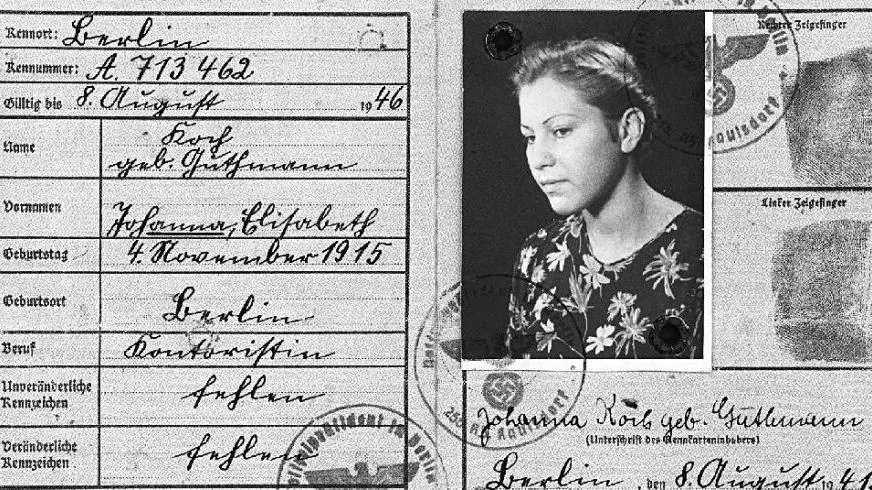
If I had to locate the exact point in time when I began thinking about preserving my mother's memories of her survival underground in Berlin during the Nazi years, I suppose it would be the day I overheard her speaking to someone on the telephone. It was obvious to me that it must be a journalist requesting an interview about her experiences during those dark years. My mother's reply was typical. "Don't you think I would be intellectually capable of writing down my own memories if I wanted to do that?" she shouted into the phone. I didn't envy the journalist on the other end of the line. Her vehement refusal left no room for discussion. She then turned to me and said, "That's the last thing I want, a stranger poking around in my past!"

I understood her point of view, but nevertheless, that incident set me thinking what a great pity it was that her story might never be preserved. I was familiar with the broad outlines and from time to time she had related individual incidents from those years, but I was far from knowing the entire story in detail. For 50 years, she had stayed largely quiet about her experience.
It really began to bother me that I, as a historian who had extensively researched the stories of numerous other Holocaust survivors, was unable to get my own mother to tell me her story. So, on December 26, 1997, without having discussed it with her beforehand, I put a tape recorder on the table in my mother's living room and said to her, "You've always wanted to tell me the story of your life—
well, go ahead."
My mother was somewhat taken aback by this sudden request but also excited by the prospect, and thus began the process of recording her memories on seventy-seven tapes. The taping continued until September 4, 1998. She died not two weeks later on September 16 of the same year.

The recording sessions followed strict rules: They were continuous, lasted between 60 and 90 minutes, and I never interrupted her with questions. The clarity and structure of her memories was remarkable. At the beginning of a recording session, my mother was able to pick up the thread of her story precisely where she had left off the time before. During those months I researched the facts she mentioned to check on the reliability of her memories. She was proud when my research confirmed what she had remembered.
I was amazed by the number and variety of people who had helped my mother to survive in various ways. She found shelter, sometimes for just one night, other times for longer periods of time, in areas of Berlin where she normally would never have gone—working-class districts and slums. An example that comes to mind is a toilet attendant, Ida Kahnke, who gave my mother shelter in her very modest, cramped one-room slum flat. It was there that my mother met the Bulgarian with whom she escaped for a short time to Bulgaria. My mother very wisely avoided going to areas of Berlin with which she was familiar and had frequented with her parents. She knew there was a danger that she would be recognized there and captured by one of the infamous Jewish "Greifer" ("Snatchers") who led the Nazis to other Jews in hiding. From time to time my mother was unable to find a bed for the night and had to walk the streets. The story she tells of defecating on the stairs in front of an apartment—with a name on the door that looked to her like it must belong to Nazis—is both tragic and comic at the same time.

Perhaps the story that moved me most was how my mother had to perform an abortion on herself all alone in a hut in a garden allotment on the outskirts of Berlin. I now live quite nearby, and the thought of what my mother must have suffered and that I lost an older brother haunts me.
That my mother had to sell her body to survive and also to make many moral compromises neither surprised me nor shocked me unduly. After all, I am a historian who has heard and read many stories of survival. I understand that those who told their stories immediately after the war were in many cases unable to be as open as my mother was so many years later; what they had experienced was still too fresh, and the people who had helped them to survive and in many cases also exploited them were still alive.

What makes my mother's story so unique and important in my view is the fact that she is utterly unsentimental in her rendition and completely frank and open. My mother had the gift of being able to describe people and events very vividly. It was typical of her to listen to and observe people closely and then describe them in a few very precise and strikingly appropriate, often devastatingly funny words. She does not make the people to whom she owed her life into shining heroes, nor are they portrayed as inveterate devils. They are simply ordinary people with strengths and weaknesses. She spares no one, least of all herself.
After recording my mother's story, my next step was transcribing the tapes and comparing the 900-page transcript against the audio. Listening to the tapes and comparing them with the transcript was something I was unable to do for quite some time after my mother's death for emotional reasons. When I finally was able to face the task, I realized what a treasure she had left behind, but I also realized that 900 pages was more than could ever be published. I then enlisted the help of a journalist with whom I have worked on various projects over the years, Irene Stratenwerth, and together we turned the long transcript into a self-contained text: Underground in Berlin by Marie Jalowicz Simon. My mother's voice speaks from every line of the book.

Preparing the manuscript entailed not only identifying the most important of the astonishing wealth of details and characters that my mother had remembered, but it also required finding the narrative thread that was always present in my mother's mind. The events that she described also had to be exactly reconstructed and verified. In the fifteen years since her death my own research into hundreds of names, addresses and lives have shown that my mother remembered almost every detail correctly. Describing the course of my research could make a book in itself.
When listening to the last of the tapes of my mother's memories, one can hear clearly how her powers are waning and the effort it cost her to continue dictating her memories. However, getting her story onto tape was so important to her—and me—that I had the strong feeling it was keeping her alive towards the end of her life.
Marie Jalowicz Simon was born in 1922 into a middle-class Jewish family. She escaped the ghettos and concentration camps during the Second World War by hiding in Berlin. After the war she was full professor of the literary cultural history of classical antiquity at the Berlin Humboldt University. Shortly before her death, her son, Hermann Simon, director of the New Synagogue Berlin Foundation-Centrum Judaicum, recorded Marie telling her story. He will act as spokesperson for the book.

Follow Marie Claire on Instagram for the latest celeb news, pretty pics, funny stuff, and an insider POV.