Blackflix
How Netflix's algorithm exposes technology's racial bias.

I 'm black and I'm proud—and Netflix knows it. Maybe it was the Scandal binge, or the fact that I watched a couple of films by black female directors, but suddenly a good third of my new movie recommendations feature black actors in leading roles. Even a category devoted to "African American Movies" has popped up in my feed.
Netflix is renowned for its uncannily spot-on—and increasingly specific—recommendation system. In years past, the company has offered a prize to whoever could improve upon its famed algorithms. And just this month, Netflix announced changes to further boost specificity by triangulating your preferences with those of viewers around the world.
Perhaps I should have assumed, then, that if movies starring black actors are tagged "African American Movies" at the same time they're tagged "Thriller" or "Family Drama," watching a few would yield a new slew of recommended picks with more racial diversity. I could have even seen that as a good thing, giving me more of what I want.
Or perhaps I could see the underlying problem, not in what we're being shown, but in what we're not being shown. I could see the fact that it's not until you express specific interest in "black" content that you see how much of it Netflix has to offer. I could see the fact that to the new viewer, whose preferences aren't yet logged and tracked by Netflix's algorithm, "black" movies and shows are, for the most part, hidden from view.
Last summer, director Gina Prince-Bythewood voiced her concern about this particular expression of Netflix's recommendation system. Her film Beyond the Lights, a serious drama about a rising pop star grappling with celebrity who finds unlikely romance, was lumped in with content like rom-com My Favorite Five. The one thing they have in common: black actors in lead roles. Other users noticed more disparate pairings: Fruitvale Station, a contemporary drama, and A Different World, a 1980s sitcom, an editor at Paste magazine observed.
There's a giant web at work behind the scenes that makes this happen. Netflix doesn't simply lump every film or show with a black lead into a single category. The company (which did not respond to inquiries for comment) employs freelancers to assign descriptive tags to all the content in its library. The tags, which are standardized by Netflix, include plot-specific categories like "suspenseful" and "cerebral" as well as identity-oriented descriptors like "African American" or "gay and lesbian." The simple result: Movies and shows are assigned to categories based on those tags, and are served up to you as suggestions for what to watch next.
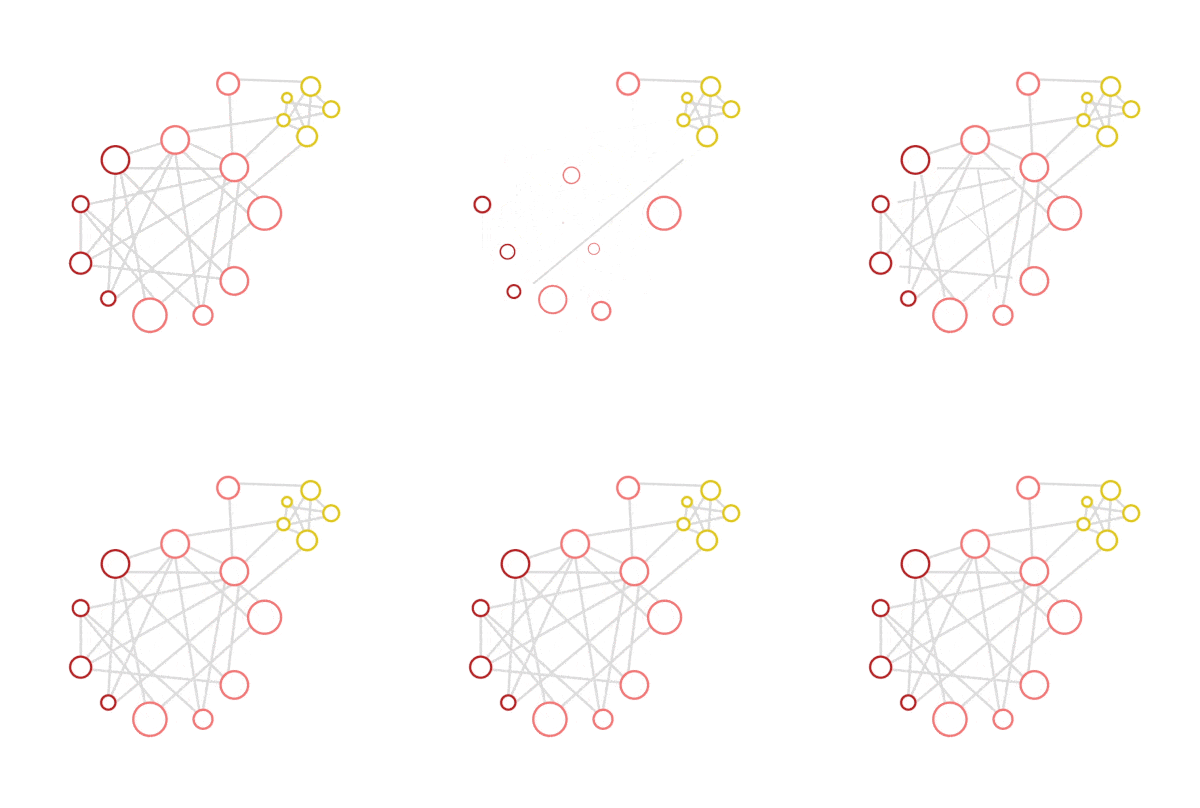
According to a former Netflix engineer who spoke with MarieClaire.com, the system generates recommendations for the "more like this" section—films that are similar to a specific title a viewer has clicked on—by also taking into account the activity of other Netflix users. So if many people have watched both Beyond the Lights and Fruitvale Station on Netflix, those titles may end up being associated with each other, even if they're otherwise dissimilar.
"Algorithms have a finely tuned ability to recognize social patterns, and they can overgeneralize those patterns," the former Netflix employee, who preferred to remain anonymous, says. Take one of my friends, who laughed about the recommendations that popped up after she watched Blue Is the Warmest Color. Among them were titles like Elena Undone and The Final Girl, as if Netflix assumed she was keen to see anything featuring lesbian sex scenes.
Of course, there can be value in categorizing films by race, sexual orientation, or other identity markers. Given how many are considered "niche" and dismissed by Hollywood's gatekeepers, as this year's hotly contested Oscars prove, it can be conducive to their success to serve them up to viewers who might enjoy them.
"black" movies and shows are, for the most part, hidden from view.
That type of reinforcement can be a boon for indie filmmakers of color, whose films often have limited budgets and as a result don't get widespread distribution or promotion offline. Alton Glass, a black director and producer whose film Cru is currently available on Netflix, argues that grouping movies starring black casts and made by black filmmakers together is an advantage: "It may be pushed to you because you're black," he says, "but how would you find it otherwise?" (The same argument has also been made of contemporary literature, as certain authors shirk or embrace labels like "women's fiction" or "queer fiction.")
In fact, for those seeking out content created by people of color, Netflix may not offer enough. The company's global expansion in January includes the whole of Africa, but as of this writing, Netflix only has 21 Nollywood films. They face competition from alternative services such as Nigeria-based iRoko, a venture-backed company that began in 2010 as a YouTube channel, which still gets some 25 million views per month, and now runs its own video-on-demand platform. Similar services are cropping up elsewhere, including California-based Afrostream, which serves French-speaking viewers, and Washington, DC-based kweliTV, which is set to launch next month with 300 titles from black filmmakers. "For our customers, they're just frustrated with the fact that the content they want to see isn't readily available on mainstream platforms," says DeShuna Spencer, kweliTV's founder and CEO.
One reason Netflix's suggestions for black films may seem so jarring, Spencer suggests, is that the service simply doesn't have a varied enough selection to serve up quality results for those films. There's some support for this argument: In a 2013 Wired article on Netflix's algorithms, vice-president of product innovation Carlos Gomez Uribe mentioned one film he'd had trouble finding similar recommendations for. The reason? There wasn't anything else in the company's library like it. As I browse Netflix's suggestions under my profile, I, too, notice that for many dramas with black casts, the same limited suggestions for related films pop up over and over again.
"It's like people are telling them, subtly, 'This is not for you.'"
There's also the slight shoving-it-down-your-throat feeling, which makes the recommendations tougher to stomach. Just because I'm black—and even though I am keen to support black filmmakers—doesn't mean every single movie or show I watch needs to feature black actors or be about "black stories." There are plenty of reasons I might want to watch Beyond the Lights: I like music-themed movies, and co-star Nate Parker—whose latest film, The Birth of a Nation, was a smash at Sundance—is bae.
That's one of the inherent drawbacks of recommendation algorithms: They're better equipped to "pare down choices rather than expand them," observes Clare Corthell, a data scientist and co-founder of Luminant Data in San Francisco. These systems work in part, she explains, by categorizing users into groups based on their behavior. So if the viewing patterns of subscribers who watch black films—who may be largely African American, though the algorithm can't tell—seem to be distinct, those subscribers will get unique recommendations, ones that other subscribers may never see.
"There's a cultural shift that has to happen, where people, basically, stop putting us in the ghetto," says Stephen Winter, a director, screenwriter, and producer whose credits include New York, I Love You and Jason and Shirley. Once, Winter says, while teaching a college course, he showed his students Get on the Bus. For many of the white students, it was their first time seeing a Spike Lee film, and they were hooked. If not for his class, they might never have realized it. "It's like people are telling them, subtly, 'This is not for you,'" he says.
In many ways, Netflix's technology is simply reflecting real-world bias. "There's always human decision-making and human bias in these platforms," says Safiya Noble, an assistant professor at UCLA's Graduate School of Education and Information Studies who examines the intersection between technology and cultural bias. Indeed, the former Netflix engineer echoes this: Those who work with recommendation algorithms are trained to recognize and account for these factors. But biases still slip through.

One issue, Noble says, is that tech services are usually aimed squarely at the mass market and aren't designed to focus on the needs of specific groups, so companies often rely on flawed assumptions regarding those groups—say, perhaps, that a cast's racial makeup is as important to the viewer as whether the film is a rom-com or a thriller.
Compounding it all is the fact that people of color, as well as women, are notoriously underrepresented in the tech industry; the software engineers working behind the scenes may not even be aware of the bias those groups are sensitive to. Noble teaches a class at UCLA that examines this effect. The course's premise is, essentially, that technology is not neutral: It picks up on human biases, even unconscious ones, and magnifies them. "Many of my students tell me they have never been exposed to this kind of thinking," she says.
At the end of the day, statistics can't reveal everything, and can paint a picture with unfairly broad strokes. "Why you really liked a movie isn't necessarily visible in the click data," Corthell says.
That's the challenge Netflix has to grapple with. After all, black films—just like black people—aren't a monolith.